Appearance
Traditions
The Buddha taught in India around 2,500 years ago. After his death, his followers gradually split into different schools. Today, most Buddhist practice falls into three broad families.
On "lineage": Buddhists use this word in a few ways. Sometimes it means the formal chain of teacher-to-student transmission (especially important in Zen). Sometimes it refers to a whole school or tradition (like the four schools of Tibetan Buddhism). Sometimes it just describes a practice community with a shared style and heritage.
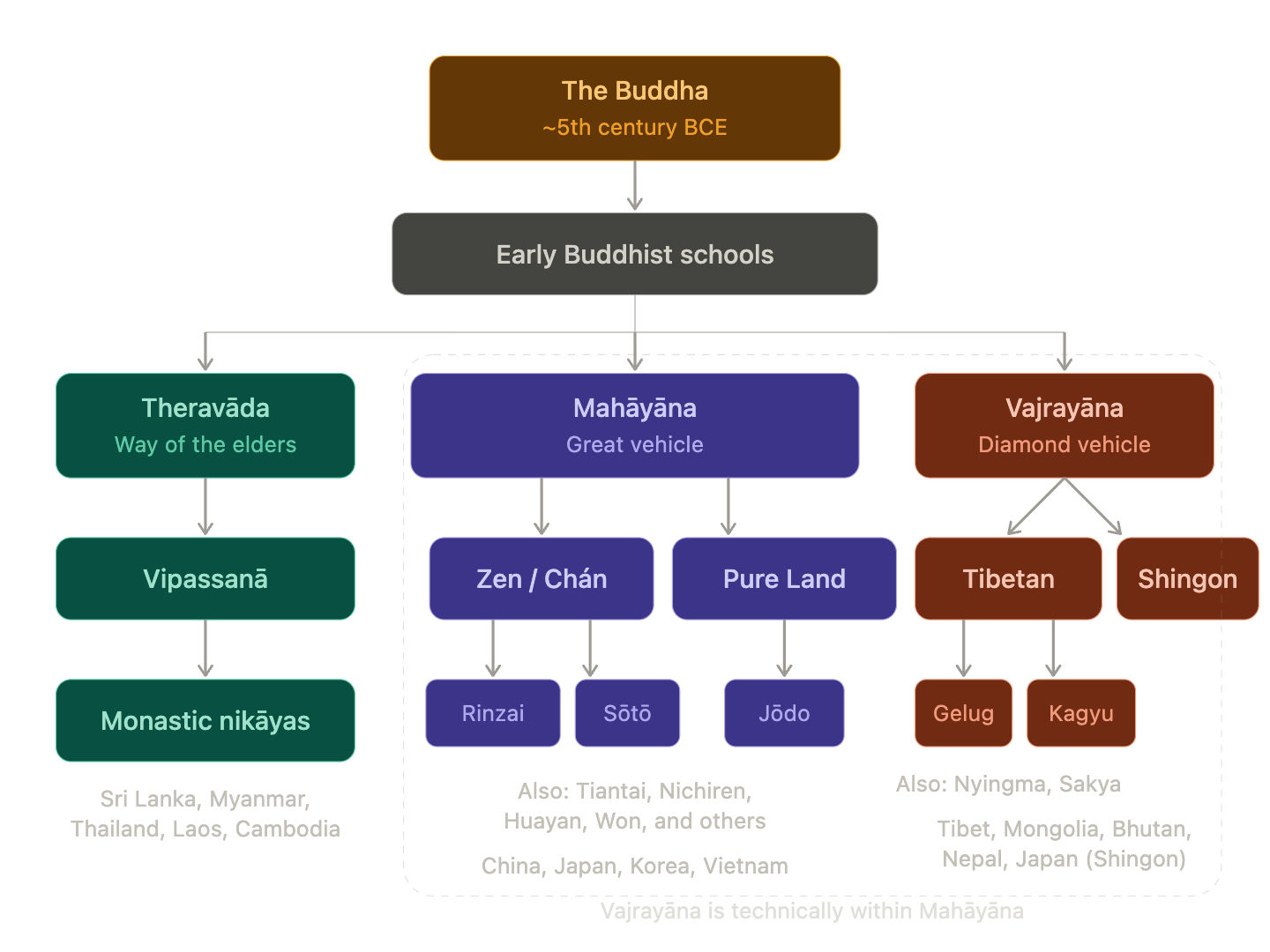
Theravāda ("the way of the elders")
The oldest surviving tradition. Theravāda sticks close to the original teachings as preserved in the Pali Canon, a huge collection of texts in an ancient Indian language. The goal is personal liberation from suffering through meditation, ethical conduct, and wisdom. Monks and nuns follow a detailed code of discipline, and monasteries are central to community life.
Mahāyāna ("the great vehicle")
Emerged a few centuries after the Buddha and expanded the vision: rather than seeking liberation for yourself alone, the ideal is to become a bodhisattva, someone who works toward the awakening of all beings. This family includes many sub-traditions. Zen (meditation and direct insight, big in Japan, Korea, Vietnam) and Pure Land (devotion and faith, the most widely practiced form of Buddhism in East Asia) are the best known. Others include Nichiren, Tiantai, and Huayan.
Vajrayāna ("the diamond vehicle")
Technically a branch within Mahāyāna, but distinct enough that it's usually talked about separately. Vajrayāna adds tantric practices (visualisations, mantras, rituals, close work with a teacher) as a way to speed up the path to awakening. The most prominent form is Tibetan Buddhism, which has four major schools (Gelug, Kagyu, Nyingma, Sakya). The Dalai Lama belongs to the Gelug school. Shingon, practiced in Japan, is another Vajrayāna tradition.